
Davis Forever: The blog I never told anyone about (until now)
As I review lots of my past websites and blogs, it’s time to reveal one of the more unusual sites that I set up. I once secretly ran a blog under a made-up name, writing about strange goings-on in Davis, California. Here's a confession about it that I've never made before.
I’ve been slowly trying to catalogue all of the websites and blogs that I have ever been involved with. This led me to a recent blog post where I looked back at the first ever website that I made.
Now it is time to reveal the details of a blog that I once created, which I kept entirely secret from anyone.
Davis Forever
When I was living in Davis, California, I decided to create a blog (‘Davis Forever’) that commented on strange goings-on that happened in the city. This was a TypePad-hosted blog that was accessible at davisforever.com (a domain I owned at the time). For about a year, the blog posted various anecdotes about unusual things happening in Davis.
None of it was real though. I just made everything up. This is the first time I have admitted to this ruse.

I also had a Twitter account at the time to promote the blog and this was used to comment on other things happening in Davis. The blog’s author was ‘CJ’ and I purchased this stock photography image to use as the ‘face’ of the blog.
Even though the blog has long since disappeared, thanks to archive.org I’ve been able to recover the posts, and I’ve included my three favourite posts below. I’m not altogether sure as to why I created this blog. It was a lot of effort to put together for a site which almost no-one noticed. Apologies to anyone who was taken in by any of these (hopefully harmless) posts.
Favourite Davis Forever blog posts
The Traffic Lights Turn Blue Tomorrow
Posted by CJ on May 28, 2009 at 10:38 PM
Some people reading this will perhaps think I am referring to lyrics from the classic Jimi Hendrix song, The Wind Cries Mary. But no. This is a blog about Davis, California remember? The place where toads get tunnels built for them to help them cross the road, the place where crazy things can - and do - happen.
Well the latest wacky idea comes from Mr Hector P. Schulz of Antioch Drive, Davis. He has suggested to the town council that Davis should honor the forthcoming Independence Day celebrations in a particularly novel way. His suggestion is that all traffic lights in Davis should have a custom color makeover just for July 4th. And of course he wants those colors to be red, white, and blue. The following image is the picture that he created to show how this might look.
<image no longer available>
It seems though that he didn't provide any explanation as to how this would be done or the potential costs that would be involved. It might be a fun idea to try, crazy and potentially dangerous, but fun nevertheless. I somehow think that this is one far out idea that our beloved council will not embrace, though you never know...!
Think you know Davis... what about Davis, Illinois?
Posted by CJ on June 03, 2009 at 09:58 PM
Despite my occasional mocking of some of the peculiar decisions that sometimes are made in this town, I still love Davis and I'm thoroughly enjoying living here. Until today, if someone mentioned 'Davis' then there is only one place that I would think of. That is no longer the case. You probably don't know but our great country is blessed by three other places called Davis (in Oklahoma, West Virginia and Illinois). If we also consider the original name of Davis (which was Davisville) then there are also name-sake towns in Texas, Missouri, Alabama, Kentucky, and Rhode Island. Furthermore, if we extend our search to include 'Davis City' then there is also a place of that name in Iowa.
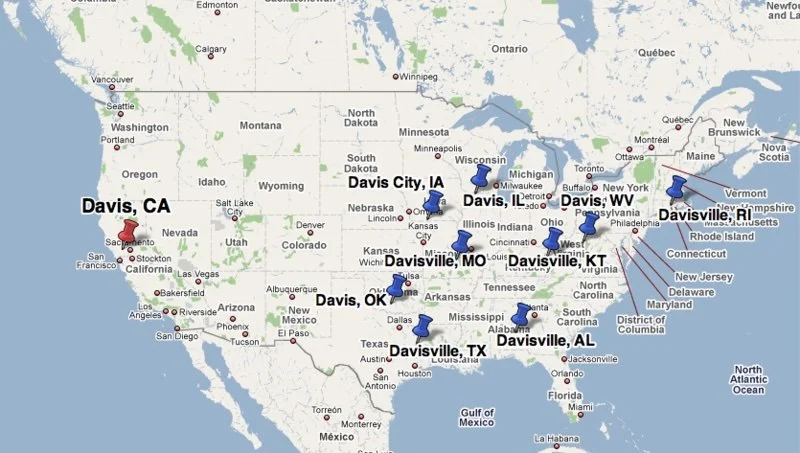
So why does it matter that our town is not unique (at least with respect to its name... it certainly is unique in many other ways)? Well, one of our fellow Davisites thinks that we should settle the question of which Davis is the best Davis by way of staging an inter-Davis contest. The plan (which is only tentative at the moment, but will possibly be submitted to the city council in the coming weeks) would be to invite representatives from our name-sake locations to Davis and challenge them at a number of events. Each Davis(-ville, City) would choose their own event, so I'm guessing that any event that we (Davis, California) nominated would surely feature cycling. Anyone have any ideas for what events we would be good at? I'm sure that if this actually goes ahead, then this would be the sort of competition where crazy events would probably be more suitable (how about a tree-hugging contest?).
I'm not sure if it would be entirely fair to do this all on home turf, but then if events had to be staged at every different location then that's going to get a bit complex to organize (and expensive too). Actually, I think there was some discussion that if this was successful, it could become an annual feature and each year would take place in a different Davis. Now I'm sure that all of the other Davis's, Davisvilles, and Davis Cities are very pleasant places to live, so I'm not sure if we want to risk creating rivalries by claiming that any one Davis is better than any other. However, I guess this could be a lot of fun and probably would be good publicity for Davis. I've said it before, and I'll say it again: I love Davis... all of them!
A Davis Conversation
Posted by CJ on June 20, 2009 at 05:05 PM
This blog post deals with something unusual which happened to me (normally I only hear about these things from other people). Earlier this week I was walking down E St, about to grab an iced-coffee from Peet's when a car pulled over next to me.
The driver, a man in his mid- to late-fifties, proceeded to ask me whether I lived in Davis and whether I could help him with directions. Now as a loyal citizen of this great, little town, I was only too happy to oblige him. After all, shouldn't we all offer a warm welcome to any outsider who happens to be visiting Davis. The rest of the conversation went something like this:
Him: So I'm looking for the Davis Walmart store.
Me: Ah, I don't think there is a Walmart in Davis Sir.
Him: You kidding me?
Me: No, I'm pretty sure about this Sir. It's a small town and I've lived here a while now. Was there something specific you were looking for, maybe another store in town might have what you want.
Him: I was looking for a Walmart... the Davis Walmart.
At this point he seemed to be getting a little uptight. I proceeded as best I could.
Me: I'm really sorry, but there isn't a Walmart in Davis. We have an Ace hardware and homeware store, we almost have a Target store, but we really don't have a Walmart.
Him: So you're calling Ernie a liar?
Me: Umm, who's Ernie?
Him: My cousin. He's the one that told me about the Davis Walmart.
Me: Oh I see. And Ernie lives in Davis?
Him: No. In Ohio. So where's the Walmart then? Ernie wouldn't lie to me.
By this point I was half tempted to just walk away. But I tried staying calm and proceeded to help him.
Me: Sir, maybe your cousin was referring to the Walmart in Sacramento, or the Walmart in Dixon, or the Walmart in Woodland. They are all pretty close to Davis, just 15 minutes drive east, west, or north of here.
Him: Look miss, I am not talking about any of these other so-called Walmarts. I'm talking about the Davis Walmart. I need to get to the Davis Walmart, now would you please tell me where it is?
Me (exasperated by this point): Sir, I can't do that... because there really is no Walmart in Davis, I don't know how else I can say this. But if you like, I can show you how to get to one of the other...
Him: Forget it! I always thought this town looked like the sort of place where no-one would stop to help someone. You're the third idiot now who's refused to tell me where you are hiding the Walmart. If you won't tell me where it is, I'll just drive around until I find it. I ain't no quitter!
And that was that. He drove off, last seen heading north on E St. A very rude man, in search of the mysterious lost Walmart of Davis. Maybe this is some sort of underground campaign by Walmart to get a store opened here. They'll keep sending people here who are trying to find it in the hope that the city caves in and builds the store for them.
Keep on blogging
A blog post about the many different blogs that I’ve had over the years and about my desire to hopefully blog more going forwards.
I surprised myself last week by writing almost 2,000 words for a new post on my ACGT science blog. This post came very easily to me and I would go so far as to say it was an enjoyable experience, reminiscing about a decision I was involved in over 20 years ago to decide a new set of gene identifiers for a model organism database:
The ACGT blog was something I started back in 2012 when I was an active science researcher at the Genome Center in UC Davis. I had lots of things on my mind from my research and found it a great way to get things off my chest. My first post is still up:
I went on to write another 300 or so posts while I was still an active scientist. Many of the posts that I wrote — particularly my deep dives into how some bioinformatics program worked — have turned out to be ‘evergreen’ content and continue to receive a lot of traffic (over 10,000 visits for the entire website last year!):
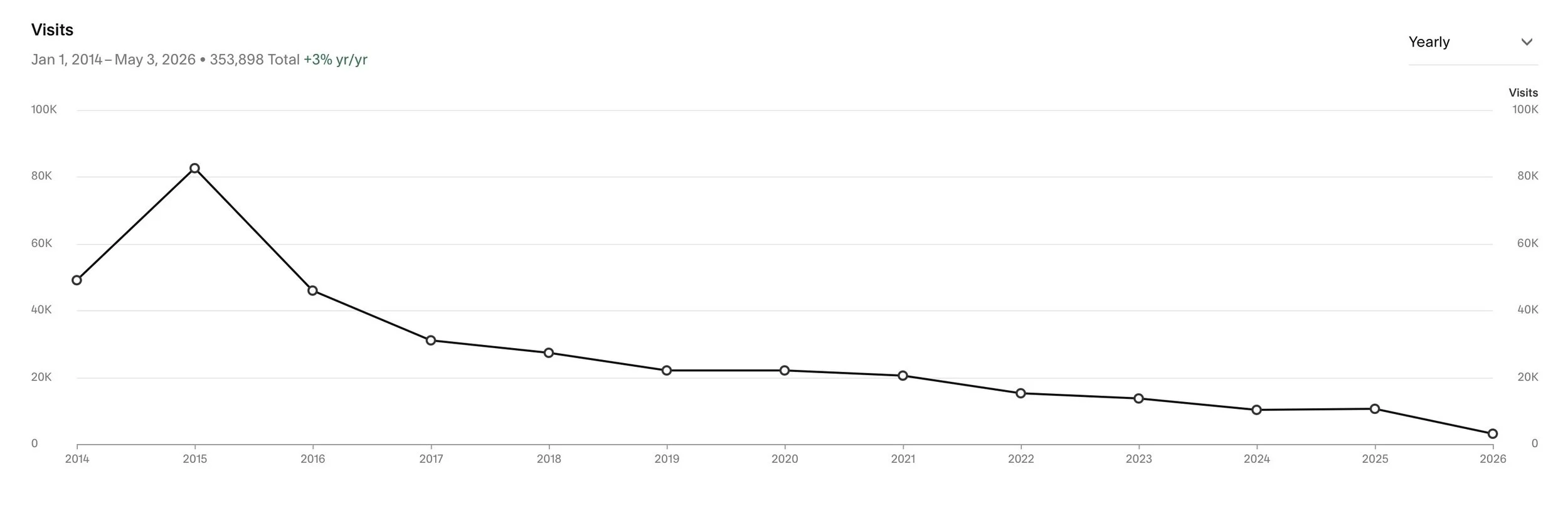
Line chart showing yearly visits to my ACGT website since 2014 (data from Squarespace analytics)
My most popular post continues to be a nerdy deep-dive article that I wrote back in 2014 about some particular pieces of bioinformatics software:
Understanding MAPQ scores in SAM files: does 37 = 42?
This post received over 2,500 views last year — over a quarter of all of the website’s traffic! — though I am expecting this sort of traffic to slowly dry up now that AI tools will give people accurate enough answers without the need to read all of the underlying material.
Post-science blogging
After I left science research in November 2015 and moved into science communication (January 2016), I still had some ideas for blog content. Including my recent post outlined at the top of this post, I’ve managed to publish almost 40 ACGT blog posts since then, though very few in recent years (and only three since 2022).
I like the idea that (very) occasionally I have an idea for something that is still relevant (and might even be of interest to people). So I’m happy to continue paying for the ACGT.me domain name and hosting the content for long as there is interest in the content.
Other blogs
In the past I once had an Apple iWeb blog which relived memories of my time at secondary school (age 10-13). Sadly, that was all lost at some point (I’m generally better about saving blog posts these days).
When I lived in Davis, CA I ended up writing some blog posts for the local newspaper (the Davis Enterprise). These seem to still be up, but are now paywalled. One of my favourite posts there was a reflection on the life of my grandad, written shortly after he died.
I still have my Molluskan Zodiac blog (the only blog devoted to molluskan-themed horoscopes that are generated by a Perl script) which is still updated weekly. I’ve also tried a Medium blog about social media analytics (which is still online, but defunct), a tumblr blog that described the 5-star rated songs in my music library, and many more (including a short-lived technology blog which is still technically online but somewhat hidden).
There are other blogs too that I won’t even mention. So I’ve blogged a lot in the past, have been through a relatively quiet period, but hope to gain a bit more enthusiasm going forwards. And this brings me to…
This blog
Away from the active, but infrequently updated, ACGT blog, I obviously have this blog that you (dear reader) are reading now. I started this around the same time as my ACGT blog, but since 2022 I’ve only managed seven posts here. So not exactly proflific, but at least that’s more than twice as many posts as on the ACGT blog. However, I’m trying to be better about coming up with ideas for this blog.
Given that my main job involves digital communications, and that I am a volunteer at a charity where I manage their website and social media, it makes sense that this is a topic I should feel able to write about.
I did make my post earlier this year on dark social web traffic and I will try to think of more things like this where maybe I have something useful to say.
I think I also need to be less precious about waiting for a really good idea before writing something. If I want to get back into blogging (which I do), then it is probably more important for me to write things which might be rough thoughts, not yet fully formed.
Additionally, I also think, that I shouldn’t be precious in wanting to only write about digital communications. So maybe this blog will need to ‘find its way’ a bit for me to better identify what it is that I enjoy writing about.
If you’ve got this far, then thank you and if you are also a fellow blogger, then it goes without saying that you should please keep on blogging.
Thoughts on the unpredictability of which social media posts will be popular
I tweet a lot and I write a lot on my blogs, especially on my ACGT blog. Sometimes I write things where I think: This…this is the one that will go viral. And of course it never happens that way. The more I try to engineer a meme, the less likely the chance of success seems to be. This is why my concept of a #MexicanTweetOff never went anywhere, and that no-one seemed to get the joke in my recent #IamSpartacash tweet:
"Hello, I'm Johnny Cash"
"No, I am Johnny Cash"
"No…I'm Johnny Cash"
#IamSpartacash pic.twitter.com/Z0n7seqSeJ
— Keith Bradnam (@kbradnam) August 28, 2015But then there are those tweets and blog posts which I think won't be of that much interest to anyone, but turn out to be the most popular things I've ever written. This week has been surprising in that two of my social media posts have taken on a life of their own.
Everyone loves a good gnome story
First, I spotted the opportunity to have a bit of fun with Genomics England. Last Thursday was a big news day for them with the project being featured in Nature. So after seeing the piece in Nature early on Thursday morning, I came up with this:
Excited to announce my new company: 'Gnomics England'. We will be sequencing the genomes of 100,000 gnome owners. pic.twitter.com/Tjpi5PQg0R
— Keith Bradnam (@kbradnam) August 27, 2015This tweet went on to have over 40 retweets and Genomics England ended up featuring me in a storify article on Friday about their news of the previous day. To date, that tweet has reached an audience of over 67,000 people on twitter!
Microsoft as a tool for bioinformatics
Then on Friday I was trying to find an image to use in a talk. I wanted to make a point about Excel often being an inappropriate tool for the management/querying of biological data, and just wanted a picture of Excel containing some sort of biological data. I was quite surprised by the image that I eventually found, and immediately shared it in a quick blog post:
Admittedly. the 'NFSW' part of the blog post title was a tactic designed to deliberately provoke curiosity. I tweeted about the blog post on Friday afternoon, a time which normally doesn't provoke a lot of interest (many of my European followers will have gone to bed by this point).
But it seems that this post hit a nerve and it has subsequently taken on a life of its own. Currently, there has been 64 retweets and 44 favorites, and now it is being spread on Facebook. By the end of Friday, it had become the most read item on my blog for the entire week (this never happens for posts I publish on Friday afternoons). I assumed that traffic would die down on Saturday but that didn't happen. By the end of Saturday, the post was my most read article of anything I have posted in the last 4 months.
At this point I assumed that things would surely quiet down on Sunday, but that didn't happen either. Traffic to my blog doubled compared to Saturday, and the post has now become the most viewed article of anything I have written in 2015, with almost 3x the page views compared to the next most-read article.
I guess the message here is that I should stop trying to predict the popularity of my social media posts!
No more science…at least not on this blog
I've decided that as I'm increasingly using this blog to write about science-related topics (bioinformatics in particular), that they should have a new home. Therefore, all of my existing genomics and bioinformatics blog posts have been copied to my new ACGT blog:
I have also removed these posts from this site so that (ultimately) they will only show up in one place in search engine results. Going forward, I will use the ACGT blog to write about anything that is predominantly science related. In contrast, this blog will now be used almost exclusively for stuff that is not primarily related to my research work.
Updated 2015-11-12 to reflect that I have now removed the posts that were duplicated between this blog and ACGT.
7 reasons why I don't like content 'aggregators' who scrape blog sites
Today a post on twitter drew my attention to Bioinfo-Bloggers, a site that aggregates content — i.e. the full blog post is reproduced — from 28 different bloggers who write about bioinformatics and genomics.
Outwardly, this might seem like a good idea. The bloggers get more exposure to their material, and readers can visit just one site instead of 28 separate RSS feeds. However, there are several reasons why I have issues with this type of aggregation. Many of my concerns apply even when individual bloggers have expressly licensed their material for reuse (e.g. by use of a CC0 Creative Commons license).
- The site lists the 28 blogs as 'contributors' and lists the blog writers as 'authors'. This strongly suggests that the people in question have consented to their material being used, even when this is not the case.
- Links to the original blog posts are included, but only at the end of each reproduced entry. The included text says that 'This is a syndicated post', further suggesting that the original authors agreed to have their content syndicated.
- The Bioinfo-Bloggers website asserts copyright over all material (see footer section of website).
- The original bloggers lose web traffic. This can matter for minor reasons such as when you want to include details of how popular your blog is for outreach sections on research grants. But it potentially — depending on how much traffic Bioinfo-bloggers gets — deprives you of knowing who is looking at your content, which articles are more popular, etc.
- People don't a chance to comment on your blog (unless they follow the links). You may lose some direct engagement with your readers.
- If people start using this site rather than viewing your blog, what happens if Bioinfo-Bloggers stops including your blog site, or shuts down altogether? In the former case, people might just assume you are not posting any more.
- What happens if Bioinfo-Bloggers starts including content from other blogs that you don't approve of? Your blog post may appear alongside another which espouses views you find offensive.
The first three points could easily be addressed by removing the claim of copyright over all material, by making it explicit that this site is just scraping other sites and that the original bloggers may not be aware of this, and by placing links to the original blog content at the top (not bottom) of each article.
There are currently some ongoing discussions about this on Twitter. E.g.
.@kbradnam *shrug* coming from open source, you sort of get used to stuff being used however. Relevance > details for me. YMMV!
— Titus Brown (@ctitusbrown) November 5, 2013
@BioMickWatson @kbradnam @ctitusbrown @BioinfoBloggers - lower left hand side "Copyright © 2013 Bioinfo-Bloggers. All Rights Reserved"
— Casey Bergman (@caseybergman) November 5, 2013
A new home
Moving home is listed among the most stressful events that one can experience in a lifetime. I wonder if 'moving blogs' should be included in that list too?
My first forays into blogging were around the time that Apple had just launched a set of tools under the '.Mac' umbrella. These tools were a successor to an earlier suite called 'iTools' and were in turn succeeded by the ill-fated MobileMe service (Dan Moren provides a good overview of these early transitions).
Under iTools and .Mac, Apple provided a web-based tool called HomePage that allowed you to create simple websites. As I recall, it was painfully slow to use and not very flexible. In 2006, things improved somewhat as Apple released iWeb, a desktop application that was part of the iLife suite of tools and which let you create websites that could be hosted on your iDisk (though you could also publish to other hosts).
The iWeb application made it relatively easy to create various different styles of website, and included a dedicated template for blogs. I used iWeb for a long time — hosting several different blogs, and my own personal website — before realizing that there were many things you couldn't easily do with the service. Support for iDisk-hosted websites continued as Apple transitioned to MobileMe, but the life-support cable for this service is about to yanked out, with Apple wanting people to migrate to its free — but iWeb-incompatible — iCloud service. Support for any iDisk-hosted sites will expire on June 30th and presumably these sites — along with any other files you may still have on your iDisk — will simply disappear.
Even before Apple announced iCloud, I had already been looking around for a alternative service to use for simple blogging and had started to use Posterous. Late last year, Posterous undertook some rebranding and became 'Posterous Spaces' with more of an emphasis on sharing and becoming a social network in its own right. This concerned me a little bit as I felt that Posterous's strength was in its simplicity, and Posterous Spaces seemed to suffer from a lack of focus. Further alarm bells rang earlier this year Posterous announced that they had been bought by Twitter. Although they claim that the service will "remain up and running", I'm now concerned that I can't count on Posterous as a long-term blogging solution.
All of which brings me — the writer — and you — the reader — to Squarespace. I've been hearing a lot about this company from many of the 5by5 podcasts that I listen to. For a low monthly fee, Squarespace will let you build beautiful websites to meet any need you have. So I'm now using Squarespace to host both my main website and my blog. It's been a useful opportunity to remove a lot of old content and try to give my website a much cleaner look. I'm still debating whether I should let all of my earlier blog posts remain on Posterous, or whether I should try to migrate them all to this site. In any case I'm really happy with the Squarespace service and hope to stay here for many years to come.