2,000 links and one new colour
It was recently World Refugee Day (20 June) and for much of the last six months I have been racing to help launch a new website project for the Careif charity where I volunteer my time.
We chose 20 June as our target launch date for CARE - the Careif Archive of Refugee Empowerment. CARE is a collection of resources relating to the mental health of refugees and asylum seekers aimed at both professionals working in these areas as well as those directly affected and in need of help. You can read more about it in the launch news story which I wrote.
I’ve been helping build these pages at Careif since last year. There is a lot of content (it brings together links to over 2,000 external resources) and it means that the number of pages at Careif has effectively tripled.
Building the site
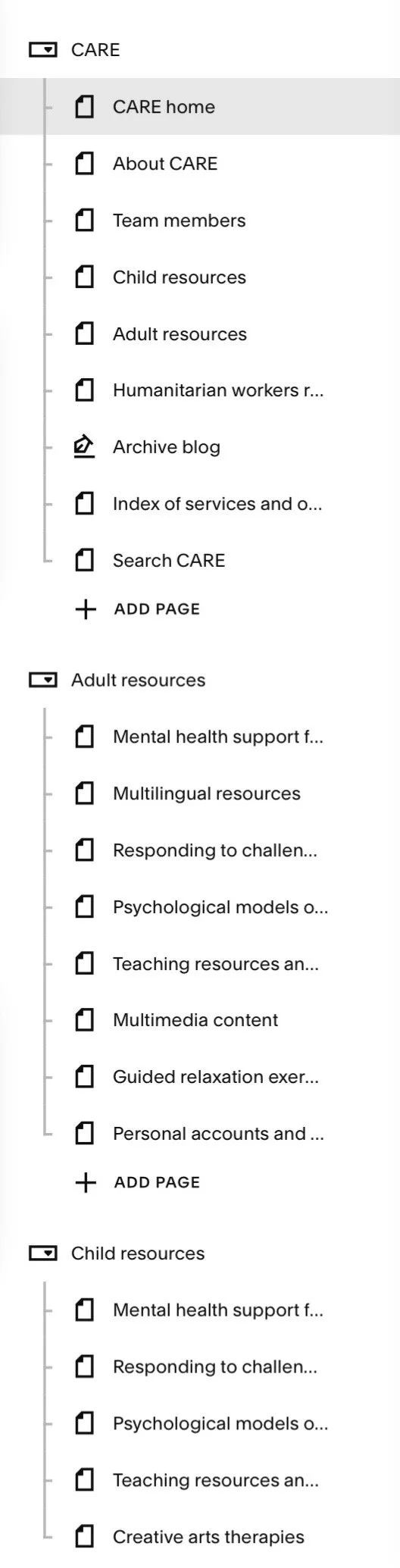
Squarespace page folders
Although there were some talks about whether this might be a completely separate website to Careif, we decided to build it as part of the site.
That has led to a few challenges in working with the Squarespace CMS. Although Squarespace lets you arrange pages in folders, you can only have one level of hierarchy. The new CARE pages predominantly concern adult resources and child resources, but there are also other sections (e.g. resources for humanitarian workers).
I can create URLs for all of these pages that reflect this hierarchy, e.g.
careif.org/care/adult-resources
careif.org/care/child-resources
careif.org/care/humanitarian-resources
However, Squarespace doesn’t let you recreate that hierarchy visually in the CMS. This is because, although you can create folders to help arrange pages, they can only be one level deep (I think the primary purpose of folders is to arrange pages that will appear in navigation menus). This may seem a minor point but I think it points to the challenges of using Squarespace if you are going to develop a big website.
So I ended up having to create three separate folders to make it easier to manage these pages, with one folder each for adult and child resources and another folder for everything else.
A new colour
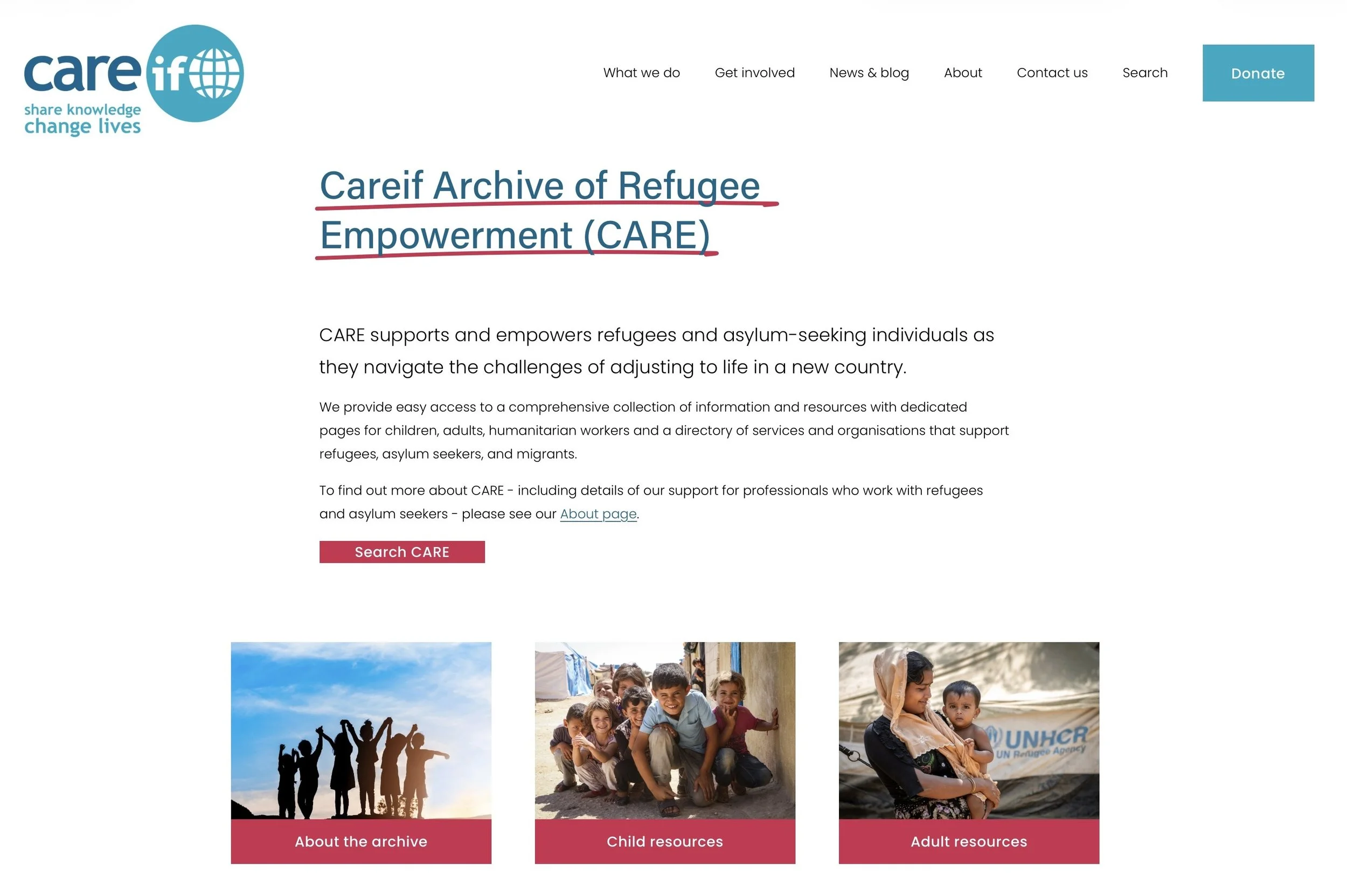
When building the ‘new’ Careif website a few years ago, I had settled on a very simple colour palette which was based on the (pre-existing) Careif logo. As the CARE pages have greatly expanded the Careif site, I felt like we needed one new colour to be used on CARE pages which was distinct from the existing colours but which still complemented them.
Using one of the many online colour palette tools that you can find (I used the excellent coolors), I settled on ‘raspberry’ as the CARE accent colour. This is applied as an underline on page titles and also as a new secondary button colour.
Rethinking the content model
There is still work to be done in creating one more page of resources for CARE. In putting these pages together, I feel that ultimately all of the page content should be completely rebuilt as some form of database with all resources tagged/categorised appropriately.
One possible solution for this in Squarespace would be to create every individual resource as its own blog post (with relevant tags/categories applied) and then use a third-party plugin to have a front-end that lets you search and filter all blog posts.
This would be a lot of work but could make managing the content easier as there would only be one content item (a blog post) for each resource, whereas currently some individual resources are duplicated across different pages.
Tackling link rot
Now that the site has grown so much, an additional challenge is to be better at checking for ‘link rot’. With over 2,000 links to external sites, we can expect those links to break regularly as sites shut down, get merged with other organisations, or just rearrange all of their content. This is a common challenge with managing any site that links to a lot of external material.
At RCPsych we use Dr Link Check to find broken links (there are various paid plans available) and I think we will try using this at Careif too now.
Time for a break
This has been a lot of work to get the CARE pages together and it is pleasing to see that they are already generating traffic. For me personally, this is now the third big piece of web development I’ve done outside of work this year. I’ve built an artist’s website for a friend (meganyelets.com), I’ve rebuilt this website and now I’ve helped launch CARE. I think I have earned a summer break now!