
Slides and video from my exit seminar [Link]
Over on my ACGT blog, I've included slides and videos from my exit seminar today at UC Davis. I enjoyed the opportunity to say goodbye in an informal and (hopefully) entertaining presentation.
Keith Bradnam is leaving the building: come to my informal 'exit seminar' on 20th November

The UC Davis Genome and Biomedical Sciences Facility, home to the Genome Center.
Next week is my last week at the UC Davis Genome Center. After almost 11 years, I will be saying goodbye as our family makes plans to return to the UK at the end of December. I will be giving a highly informal, and hopefully entertaining, exit seminar…the title is as follows:
Assemblathon to Zykovich: an A-Z that reflects a decade at the UC Davis Genome Center
All are welcome. There will be cakes!
Friday 20th November, 10:00 am in the GBSF auditorium (room 1005)
Announcing a new Presidential-themed age metric: the POTUS Number Number (PNN)

Image from flickr user chunkysalsa
This week I turned 44. It struck me that this number is the same as the total number of American presidents, and this got me thinking about a few things:
- How many people have ever celebrated a birthday where their age matches the current POTUS number?
- What is the maximum number of times that someone has been able to match their age with the POTUS number?
- Has there ever been a sitting president who matched their POTUS number in this way?
I will define this metric — the number of times that your age matches the number of the current president as the POTUS Number Number (PNN). Here are some observations about PNNs that try to answer the above questions:
PNN = 1
The first people to ever achieve a PNN of 1 would have been those who turned 1 year old at any time beween April 30th, 1789 and March 4, 1797.
PNN = 2
People who turned one year old at any point in the last year of George Washington's presidency would — assuming they continued to live — have then been two years old during some stage of the presidency of POTUS #2. These people would therefore be the first to experience matching their POTUS number twice, i.e. gaining a PNN of 2. More generally, anyone who celebrates gaining their first PNN point in the last year of a presidency, has a good chance of gaining a second PNN point. For example, barring any bizarre gardening accidents, I will be 45 when POTUS #45 takes office on January 20, 2017. This will increment my PNN from 1 to 2.
Inaugurations: a bonus day for PNN seekers
Presidential inaugurations mark the handover of power between two presidents on a single day. Over the course of history, presidential inaugurations have happened on five different calendar dates. Before the Twentieth Amendment to the United States Constitution, inaugurations mostly took place on March 4, but since then they mostly take place on January 20. Some exceptions have been when the inauguration would fall on a Sunday, in which case it is pushed back one day.
This means, that March 4 and January 20 have probably been the days on which the most PNN points have been awarded. For example, the 2009 inauguration (on January 20) meant that that people who were turning 43 or 44 on that day could both gain a PNN point.
PNN > 2?
For a chance of advancing beyond a PNN of 2, someone would need a sitting president to serve a shorter than usual term. The president in question would also have to depart office within a year of assuming the presidency.
POTUS #9 died in office after just one month. This means that someone who turned 8 years old between March 4 and April 4, 1840 (PNN = 1) would have turned 9 during POTUS #9's ill-fated tenure in 1841 (PNN = 2), and would then have turned 10 while POTUS #10 was still in office (PNN = 3).
POTUS #20 is the only other president to serve for less than a year, and as he passed away in 1881, it means that there is no-one alive today who can still be a member of the very exclusive 'PNN = 3' club.
FDR: the scourge of PNN 2 seekers
Since the passing of the Twenty-second Amendment to the Constitution, presidents can only serve two terms in office, limiting a president to four or eight years in office (the latter occurring when a president seeks, and secures, re-election).
This amendment was introduced after the death of POTUS #32 who served as president for over 12 years. As you have the best chance of securing a 2nd PNN point if you achieve your first PNN point in the penultimate year of a presidency, FDR's long rule meant that it decreased the options for 32 year olds seeking an additional PNN point.
POTUS PNN?
Now we can turn to the important question of whether any sitting president ever achieved a PNN. As we are currently at POTUS #44, you might think this would be unlikely…and you would be correct. There have only been two presidents who took office when they were younger than 44. POTUS #26 was 42 and POTUS #35 was 43.
The closest we have come to this situation is with the current POTUS (#44), who was 47 when he took office, giving us a PNN differential of 3. POTUS #42 was the next closest with a PNN differential of 4 (he took office at the age of 46).
However, as the POTUS number continues to increase, we will surely see a sitting president gain a PNN in the near future. It could happen as soon as 2017 as there are three candidates seeking to secure the Republican Party nomination who are all aged 44 (Ted Cruz, Marco Rubio, and Bobby Jindal). However, Ted Cruz will be 45 on December 22, 2015; this means that — should he be elected President — he will miss the chance of gaining a POTUS PNN by just under a month. Given Bobby Jindal's recent polling numbers, only Marco Rubio has any sort of realistic chance of becoming POTUS #45 at age 45 (with the added benefit of joining the PNN=2 club).
No end to PNNs?
Obviously there were no PNNs to be gained before America elected their first president. This made me wonder whether one day the POTUS number will get so high that no-one will be able to gain any new PNN points, i.e. when POTUS number > average life expectancy.
The average term of office since the inauguration of POTUS #34 in 1953 is about 6 years. So we can forecast that by the year 2100, we may see the election of POTUS #59 (assuming that term limits do not change and that America, and its presidential system of government, endures).
Life expectancy will surely increase over that period as well. The average American born today has a life expectancy of about 79 years. This is just a little higher than the age of POTUS #40 when he became the oldest president to leave office at the age of 77. The UN's World Population Prospects report predicts that by 2100, average life expectancy of Americans might rise to about 88 or 91 (male and female respectively).
Based on these numbers it seens that there will be plenty of PNNs to be gained in the foreseeable future. My two-year old son may have to wait until the year 2064 or so though before he can gain his first PNN, when POTUS #53 will be in office.
That's no moon…but it is one of my favorite places to visit in Davis
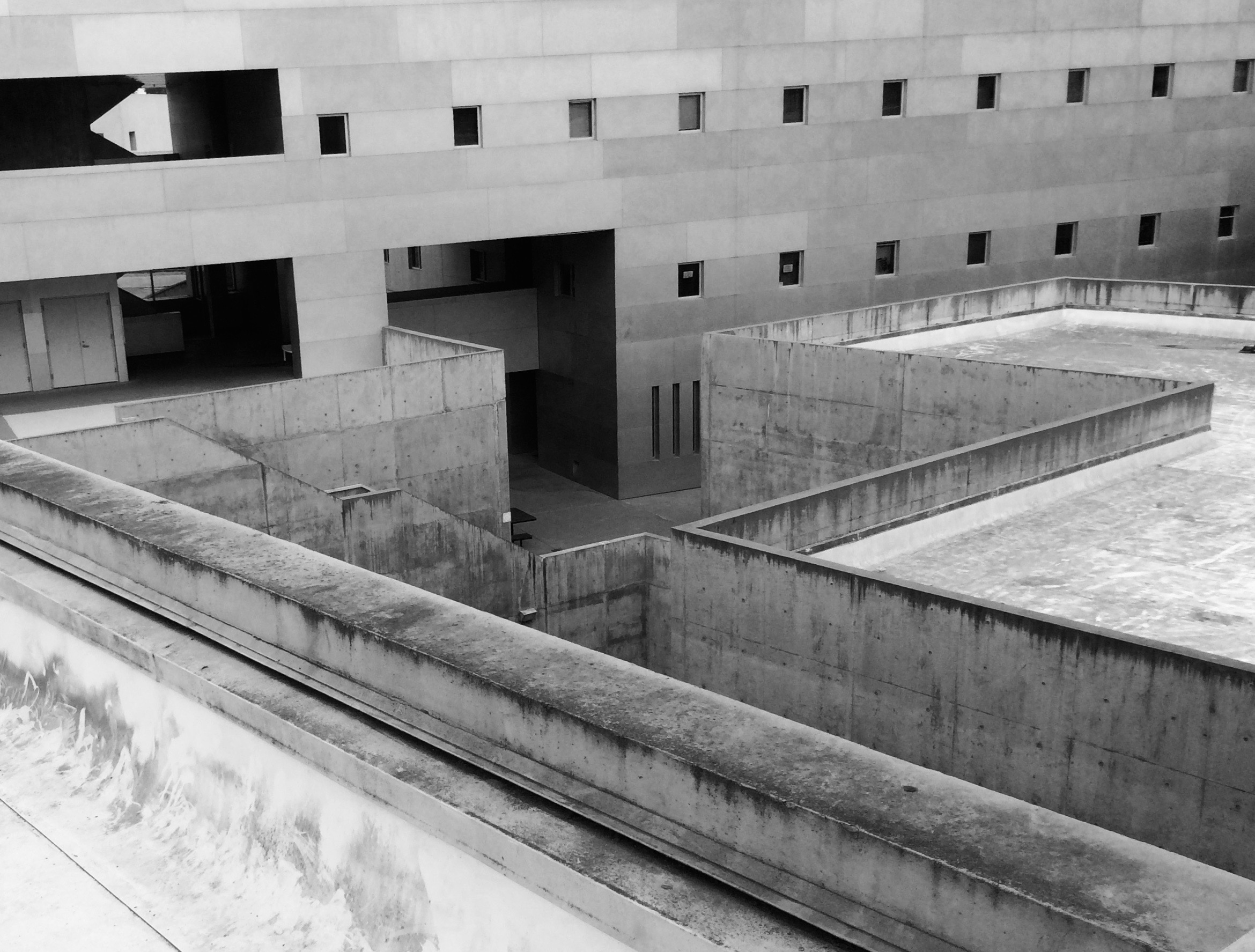
Some may know it as the UC Davis Social Sciences and Humanities Building, but for me it will always be the Death Star. It's an amazing building…well technically it is a collection of many interconncted buildings, all packed with awkward, imposing angles. It is very easy to get lost in the innards and courtyards of this building, and this (intentional) design feature is part of the charm.
No two corners (or windows) appear to be the same and there are many steps that lead you to dark nooks and crannies. Perfect spots for plotting the destruction of those Rebel scum.
If you have never visited the Death Star, then you should give yourself to the Dark Side (at least once!). Here are some black and white photos that depict the Death Star in all of its raw and powerful beauty.
Click on the pictures to enlarge…






Thoughts on the unpredictability of which social media posts will be popular
I tweet a lot and I write a lot on my blogs, especially on my ACGT blog. Sometimes I write things where I think: This…this is the one that will go viral. And of course it never happens that way. The more I try to engineer a meme, the less likely the chance of success seems to be. This is why my concept of a #MexicanTweetOff never went anywhere, and that no-one seemed to get the joke in my recent #IamSpartacash tweet:
"Hello, I'm Johnny Cash"
"No, I am Johnny Cash"
"No…I'm Johnny Cash"
#IamSpartacash pic.twitter.com/Z0n7seqSeJ
— Keith Bradnam (@kbradnam) August 28, 2015But then there are those tweets and blog posts which I think won't be of that much interest to anyone, but turn out to be the most popular things I've ever written. This week has been surprising in that two of my social media posts have taken on a life of their own.
Everyone loves a good gnome story
First, I spotted the opportunity to have a bit of fun with Genomics England. Last Thursday was a big news day for them with the project being featured in Nature. So after seeing the piece in Nature early on Thursday morning, I came up with this:
Excited to announce my new company: 'Gnomics England'. We will be sequencing the genomes of 100,000 gnome owners. pic.twitter.com/Tjpi5PQg0R
— Keith Bradnam (@kbradnam) August 27, 2015This tweet went on to have over 40 retweets and Genomics England ended up featuring me in a storify article on Friday about their news of the previous day. To date, that tweet has reached an audience of over 67,000 people on twitter!
Microsoft as a tool for bioinformatics
Then on Friday I was trying to find an image to use in a talk. I wanted to make a point about Excel often being an inappropriate tool for the management/querying of biological data, and just wanted a picture of Excel containing some sort of biological data. I was quite surprised by the image that I eventually found, and immediately shared it in a quick blog post:
Admittedly. the 'NFSW' part of the blog post title was a tactic designed to deliberately provoke curiosity. I tweeted about the blog post on Friday afternoon, a time which normally doesn't provoke a lot of interest (many of my European followers will have gone to bed by this point).
But it seems that this post hit a nerve and it has subsequently taken on a life of its own. Currently, there has been 64 retweets and 44 favorites, and now it is being spread on Facebook. By the end of Friday, it had become the most read item on my blog for the entire week (this never happens for posts I publish on Friday afternoons). I assumed that traffic would die down on Saturday but that didn't happen. By the end of Saturday, the post was my most read article of anything I have posted in the last 4 months.
At this point I assumed that things would surely quiet down on Sunday, but that didn't happen either. Traffic to my blog doubled compared to Saturday, and the post has now become the most viewed article of anything I have written in 2015, with almost 3x the page views compared to the next most-read article.
I guess the message here is that I should stop trying to predict the popularity of my social media posts!
Remixing Chris Breen's beautiful 'Space Theme' podcast music

Liftoff is a new podcast on the Relay FM network that has a delightful theme tune written by Chris Breen. The subject matter of this podcast is 'space, the universe, and everthing'.
If you listen to episode 1 of the podcast, you will only hear about 20 seconds of the beautiful theme music, and only 8 seconds without any spoken interference. This is a great shame because Chris Breen recorded a full minute of music. It is delicate, quiet, and yet expansive and deep. It is therefore perfectly suited for its subject matter. Chris — who has written many podcast themes — provides some insight into how he wrote the theme on his blog and provides a link to where you can download the music (titled Space Theme).
I found myself listening to this piece over and over again. As Chris notes in his post, this is not your typical podcast theme. In my opinion, the most amazing thing about it is the level of restraint that Chris has wielded. It would be so easy to maybe overdub a ringing electric guitar solo, or add all manner of additional tracks to fill out some of the 'space' in the music.
After I had listened to the track for a day or two, I found myself wanting more. So I took it upon myself to make a remixed version of the theme. The main reason was just to give myself more of this lovely music. So using GarageBand, I made some edits to effectively double the length of the track. Because the track has a natural ending point, I had to duplicate material just before the end, and play around to find a natural cutting point.
At this point, I felt the new second half of the song needed something extra to help build the song just a little bit more. This gave me the opportunity to add a few bars of 'Breathy Vox' to partly mask the join I had made. I then added some simple strings and a few other effects. When I saw that GarageBand had a synth sound called 'Sea of Tranquility', I felt that this had to be added.
I tried various other additions, at one point adding a quite sweet clarinet track, but I kept on coming back to the restraint that Chris had shown and felt that I had to honor that as much as possible. The screenshot below shows my final set of additions and edits in GarageBand (click to enlarge):
You can hear my version here. Thank you Chris for making a truly beautiful piece of music. I hope that the Liftoff podcast can do it more justice in future episodes!