
The Littlest Birds Sing the Prettiest Songs — or do they?
According to this video testimony from musical performers The Be Good Tanyas, ‘the littlest birds sing the prettiest songs’. If we take their claim at face value, one might presuppose that ‘size of bird’ and ‘prettiness of song’ might be connected in some form of linear relationship where smaller birds sing prettier songs:
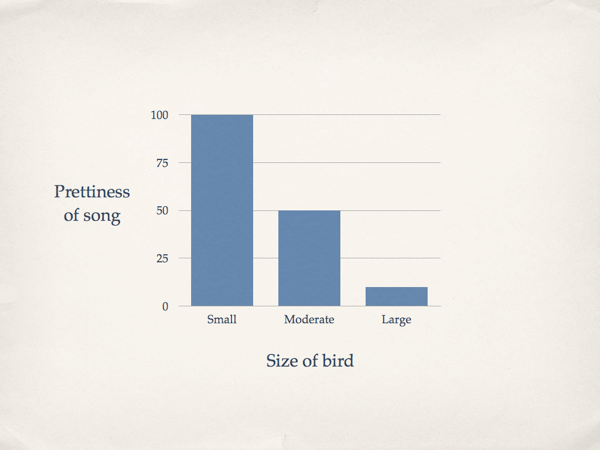 However, as they fail to clarify the nature of the relationship between ‘size of bird’ and ‘prettiness of song’ one could postulate that the following examples also satisfy their description:
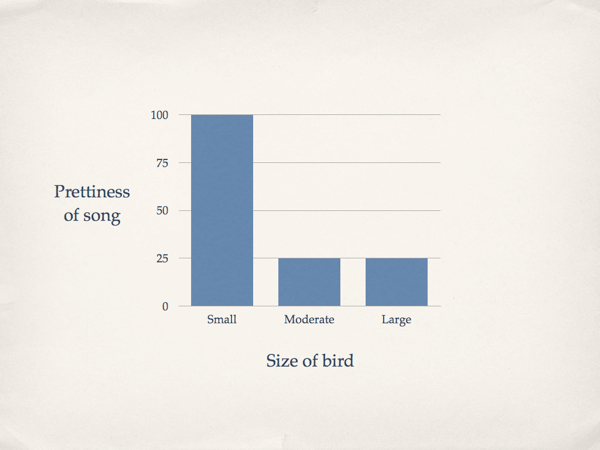
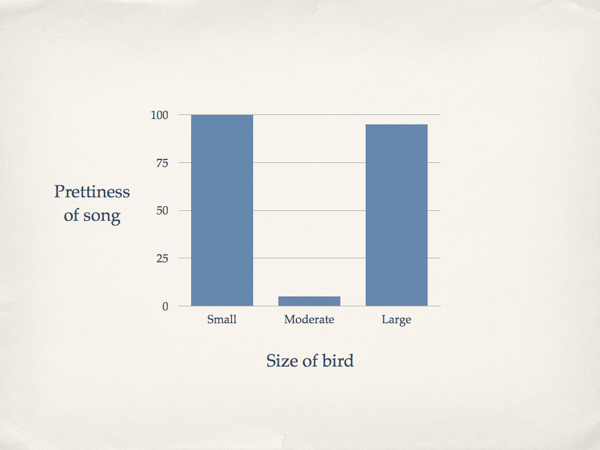
Thus we feel that — in the absence of supporting data — their observation that smaller sized avians produce more pleasing vocalizations, should not be regarded as a relationship which necessarily suggests that larger-sized birds sing notably less pretty songs.
Regardless of whether there is a relationship between these two metrics, we might still expect to find supporting evidence for the notion that diminutive avians produce trillings, warblings, and other chirruping-like sounds that are of a fetching nature.
One might therefore assume that the songs of Hummingbirds should be among the prettiest of all bird songs. However, according to the Hummingbird-themed site World of Hummingbirds:
“the sounds of hummingbirds are not exactly considered music…it would be more appropriate to call them chirps then it would be to call it music.”
This testimony, along with the audio evidence provided on their site, suggests that the claims of The Be Good Tanyas should not be taken at face value. Further undermining their claims is this list of the top ten song birds from ‘Bird On! News’. While some of the entries on this list also feature in whatbird.com’s list of small-sized birds (those birds 5–9 inches in length), the top 10 list also includes the mute swan which can grow up to 1.5 meters in length, a size described by Wikipedia as ‘impressive’.
Without published data in a peer-reviewed journal we find the evidence to support any claim that ‘the littlest birds sing the prettiest songs’ to be lacking and we humbly request that The Be Good Tanyas ‘show us the data’.
Please do not read this
Reposted from my older blog that is about to disappear.
This is a test, a little psychological play thing. I’m just curious as to how many people will proceed with reading this even though I have (kindly) asked that you refrain from doing so. Most people will come across a link to this blog post from Twitter or App.net and therefore will see nothing more than the following text: ‘Please don’t read this’ along with a shortened web link.
And yet…and yet you are here, reading these very words which I asked you not to read. You disregarded my instructions and if you are still reading this then you have thrown caution to the wind and are willing to risk the possible destruction of your computer in order to see what I had to say (have you people never heard of clickjacking?). From a psychological viewpoint, you might be interested to know that you are now a victim of my (successful) attempt at using the Pique Technique.
Of course it is entirely possible that the brave souls who have clicked on the link to arrive here actually know me (at least in a virtual way) and therefore trust that I would not do something so malicious as to cause them (or their computer/internet device) any harm. However, who is to say that I am not a sleeper agent that has been recently ‘activated’ to carry out a mission of inflicting chaos and mayhem on an unsuspecting world?
Okay folks, here is your final test. If you scroll down to the bottom of this page you will find three words waiting for you. However, I strongly suggest with all of the urgency that I can muster, that you DO NOT READ THOSE THREE WORDS! I can take no liability for what damage, psychological or otherwise, may arise from the reading of those three words. These three words have been carefully chosen for their potential to cause grave offense and so I will end this post by once again urging you that you should not, under any circumstances, scroll down to the bottom of this post to read those three words.
Moist muffin flaps.
Why I deleted my Facebook account
Reposted from my older blog that is about to disappear. Originally posted May, 2010.
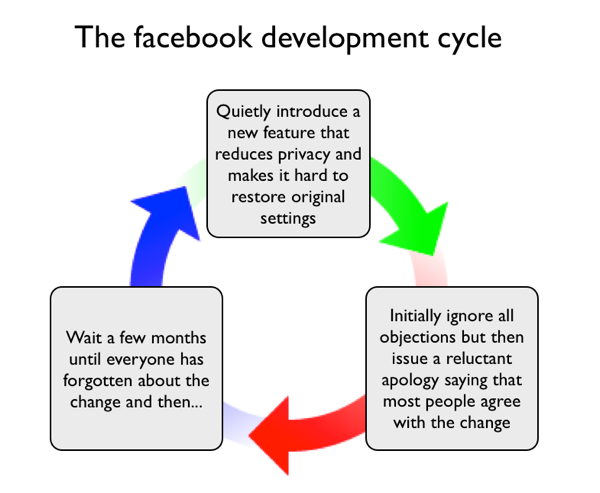
The next big set of problems with facebook came with the succession of poorly implemented design & policy changes. I’m not opposed to change but I think that even facebook will admit to having rushed through changes without properly explaining in advance what was going to happen. This seems to a recurring feature and one might depict the facebook development cycle like so:
10 rival social networking sites that may spell the end of Facebook
- Farcebook - people recount hilarious episodes of their crazy lives
- Acebook - Veterans of aerial combat recount their tales of dogfights in the sky
- Faceliftbook - exactly the same content as facebook, but with a new, younger look
- Twofacebook - sign up to praise your friends (and then bitch about them when they log off)
- Plaicebook - where people write their own recipes that feature everyone’s favorite fish
- Facecook - only for people who resemble TV chefs
- Macebook - people hook up to discuss their experiences with tear gas
- Faceoffbook - each week two site members pair up to battle to death in unarmed combat
- Visage de livre - Facebook for French people
- Face2facebook - people actually leave the computer behind and meet people in real life (not sure if this one will ever catch on)
Reposted from my older blog that is about to disappear.
Alternative Valentines Day Poems
Had some fun yesterday coming up with some alternative Valentines Day poems which I posted on Twitter using a hashtag #altValentines. I have gathered those tweets together here. I think this is a good reflection of how my mind works:
Roses are redViolets are blueBut if you paint them brownThey’ll both look like poo#altValentines
— Keith Bradnam (@kbradnam) February 14, 2013
Roses are blueViolets are redValentine color-blindnessMesses with your head#altValentines
— Keith Bradnam (@kbradnam) February 14, 2013
Roses are read,Violets are blew,I’m bad at spelling,Maybe you are two?#altValentines
— Keith Bradnam (@kbradnam) February 14, 2013
Roses are genus Rosa,Violets are genus Viola,I’m obsessed with taxonomy,Will this fact bowl you over?#altValentines
— Keith Bradnam (@kbradnam) February 14, 2013
Roses are FF 00 00,Violets are 94 00 D3,If you write HTML,This is all you can see.#altValentines
— Keith Bradnam (@kbradnam) February 14, 2013
Reorders sea,A vestibule role,Wordcraft’s the game,Anagrams the goal.#altValentines
— Keith Bradnam (@kbradnam) February 15, 2013
Roses smell like Mozart,Violets are number 32,The joys of synesthesia,I’m perceptually screwed.#altValentines
— Keith Bradnam (@kbradnam) February 15, 2013
Rose from the dead,Violence is due,I’m a Vampire in love,and I’m coming for you.#altValentines
— Keith Bradnam (@kbradnam) February 15, 2013
Roses are red,Except when they’re not,I mean, there’s hundreds of colors,Do you find pedants hot?#altValentines
— Keith Bradnam (@kbradnam) February 15, 2013
Roses are ~620–740 nanometers,Violets are ~380–450 nanometers,I’m spectrally coordinated,would you like me to greet you?#altValentines
— Keith Bradnam (@kbradnam) February 15, 2013
˙noʎ ɹoɟ ʎzzıp ɯ,ı ǝsnɐɔǝq'uʍop ʇou sı dn'ǝnןq ǝɹɐ sʇǝןoıʌ'pǝɹ ǝɹɐ ǝsoɹ#altValentines
— Keith Bradnam (@kbradnam) February 15, 2013
‘Roses’ are 10 points,‘Violets’ 78,Opening moves in Scrabble,So how about a date?
— Keith Bradnam (@kbradnam) February 15, 2013
Rose is 14542,Violet is 70092,Small towns with zip codes,Can I go there with you?#altValentines
— Keith Bradnam (@kbradnam) February 15, 2013
Roses are [redacted]██████ ███ ████,I dream of your ████,Will you █████ me too?#altValentines
— Keith Bradnam (@kbradnam) February 15, 2013
My Postprandial Thanksgiving Quiz - 2012
For the last few years I’ve tried to entertain our Thanksgiving guests with a quiz of my own devising. I wait until the guests have eaten their fill, such that their near-comatose state forbids them an easy escape. Here is this year’s quiz. Ten questions, three points per question. Answers are at the bottom.
The Quiz
1) Like everything that is good in the world, Thanksgiving in America has it’s roots in English traditions. As part of the reformation, Church holidays in England were meant to be replaced with ‘Days of Fasting’ or ‘Days of Thanksgiving’ to mark events that Puritans regarded as having special providence. In January 1606, the English Parliament passed the Observance of 5th November Act 1605, commonly known as the “Thanksgiving Act”. What event did this act recognize?
2) In the US, Thanksgiving falls on the 4th Thursday of November. When does Thanksgiving occur in Canada?
3) The West Indian island of Grenada also has a Thanksgiving Day, but it has nothing to do with the American Thanksgiving. What does their Thanksgiving Day celebrate? Choose one of the following:
- a) As the worlds second largest producer of nutmeg, they give thanks for a successful nutmeg growing season
- b) They give thanks to their 1974 independence from their former colonial overlords, the United Kingdom
- c) They give thanks for being invaded in 1983 by the United States military
4) Thanksgiving parades are a famous part of the Thanksgiving Day tradition, with Macy’s parade in New York City among the most famous. Can you match the following Thanksgiving Day parades with the cities where they occur?
- a) McDonald’s Thanksgiving Parade
- b) 6abc Dunkin Donuts Thanksgiving Parade
- c) America’s Hometown Thanksgiving Parade
5) Thanksgiving Thursday leads to Black Friday (not to mention Cyber Monday). But there is another commerce-related day that occurs on Friday, a day that started in Mexico 1992, but is now an international day of protest recognized by many. What is it?
6) The world championships of which ‘sport’ are televised each year on Thanksgiving Day on the Science Channel?
7) Turkeys are perhaps the most famous food associated with Thanksgiving, but Turduckens (a chicken stuffed inside a duck inside a turkey) are growing in popularity. Turduckens however are not the only way you can stuff one animal into another to make it into a tasty dinnertime treat. The dish known as ‘Pandora’s cushion’ is a goose stuffed with three other avian species. What are they?
8) Another way by which Turkeys are associated with Thanksgiving is the National Thanksgiving Turkey Presentation, where the President pardons a live turkey that is presented to him. According to the Eisenhower presidential library, President Eisenhower is said to have done what to the turkeys that he pardoned?
9) Turkey facts. True or false?
- a) It is forbidden to sell a turkey (the bird) in Turkey (the country)
- b) Turkeys can die of heart attacks brought on by stress
- c) in 1982, a home-reared turkey in Alexandria, Louisiana was caught eating the family’s pet chihuahua dog
10) The Daily Press, a newspaper serving Hampton, Virginia has compiled a list of ‘Top 10 Thanksgiving Foods’. We ate six of these top ten items today (Turkey, Stuffing, Mashed potatoes, Cranberry Sauce, Green bean casserole, and pumpkin pie ). What did we miss? Pick three of the remaining food items.
Scroll down to see the answers.
The Answers
1) 3 points for ‘Guy Fawkes day’ or ‘Gunpowder Plot’, 2 points for ‘Bonfire Night’ and 1 point for anything related to fireworks
2) 2nd Monday in October (1 point for each correct part of the answer)
3) All of the answers are factually correct, but the one which caused them to create a Thanksgiving day is the invasion of their country by the United States. (3 points for correct answer)
4) 1 point for each correct answer + McDonald’s Thanksgiving Parade (Chicago) + 6abc Dunkin Donuts Thanksgiving Parade (Philadelphia) + America’s Hometown Thanksgiving Parade (Plymouth, MA)
5) Buy Nothing Day (3 points), any recognition of boycotting commerce (1 point)
6) Pumpkin Chunking/Punkin Chunking (3 points), pumpkin throwing/tossing/catapults etc (2 points), anything pumpkin-related (1 point)
7) Goose -> Chicken -> Pheasant -> Quail (1 point for each of the 3 birds)
8) Ate them (3 points), cooked them (1 point)
9) 1 point for each: a) False b) True c) False
10) 1 point for each of the remaining items from the top 10 list (3 points max)
1. 2. 3. 4. Ham 5. 6. 7. Bread rolls 8. Sweet potatoes 9. 10. Turducken